Choosing a sofa: The ingredients for a perfect sofa
I’ve seen A LOT of sofas. Hundreds in fact.
Most of the time these sofas have been brought to me by customers who purchased their sofa from a big-name manufacturer and they’ve fallen apart within the first two years.
There are a number of reasons this might happen from insufficient cushion fillings to broken arms, cardboard interior, damaged springs, staples holding joints together or whatever else, and these issues are common within mass manufactured sofas.
This can be frustrating for customers who have spent a hefty fee on their new sofa, but fortunately for you, while some people might be connoisseurs of fine wine or French cuisine, my area of expertise is sofas and I’m here to stop you making expensive mistakes in the future.
Whether you’re choosing a new sofa or wanting to know if yours is worth reupholstering, there are specific ingredients that make up the perfect sofa.
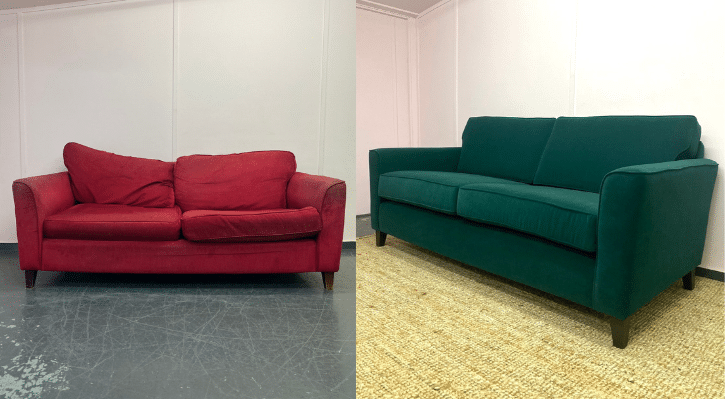
Before and after of a sofa I reupholstered with Linwood omega velvet fabric.
Comfort
With the exception of your bed, which you absolutely want to be the centrepiece of comfort and luxury in your home, your sofa has to be the next best place for curling up and getting cosy.
Statistics suggest we spend around 17 years sitting on a sofa in our lifetime! So, comfort is essential.
Comfort comes in different forms for different people, but there is one thing I won’t compromise on and that’s using the right cushion filling for each style of sofa.
The hollow fibre gives you the squishy comfort and the foam core offers support. This way, the seats and back always last longer too.
“An expert upholsterer can significantly change the comfort of a sofa”
These days, manufactured sofas tend to be quite mean with their fillings, which is why it’s a good idea to bring your cushions to an upholsterer to get them re-filled rather than having to engage in the endless cycle of constantly plumping your cushions after every use.
Equally, don’t write off a sofa that may look or feel uncomfortable on first appearance. Small tweaks by an expert upholsterer can significantly change the comfort of a sofa.
An upholsterer can also switch and change the legs of some sofas to make one that feels too low a little higher or vice versa.
And don’t underestimate the power of plumping up your cushions once a week to keep them ultra-comfortable.
Likewise, turning and rotating will help increase the lifespan of your sofa accessories. In fact, I’ve had seat cushions last up to 10 years with regular rotation.
Style
When choosing a sofa, the style you pick is going to be a reflection of your unique tastes.
You may be into sleek, mid-Century design, or it may just be all about the snuggle factor and you want the squishiest-looking style that will be a place you love to lounge.
Either way, it’s important you love it and it suits the personality you’ve created for your home.
I think it’s fine to mix and match eras and styles, so long as there is one co-ordinating theme – a colour or a style thread that links everything together.
I live in a Victorian cottage and have a mid-century sofa and armchairs, as well as a classic antique Chesterfield sofa.
It works as I’ve used different fabrics and colours to make it cohesive, while ensuring that nothing clashes, and with such a vast choice of fabrics, I had a great time tying them together using printed and plain fabrics, paying attention to the finer details, which is something you won’t get from a store-bought sofa.
The Chesterfield is a real timeless classic and a popular choice for a sofa, I think every home should have one somewhere, but it’s not everyone’s cup of tea.
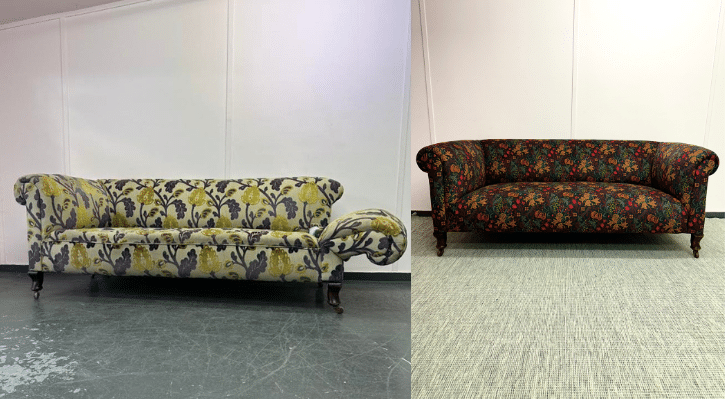
Before and after of a Chesterfield sofa I reupholstered with Mallion & Knowles Honeysuckle fabric.
It has a fixed sprung seat and back, so it’s going to be firm and they make the perfect second sofa, adding a real elegance to the room.
If you reupholster them in a print, a Chesterfield becomes the perfect statement piece of the room where you can really show your personality.
Real lounge-y sofas tend to have a more substantial seat, back and possibly side cushions and getting the right filling and the right amount of filling for the cushions is key with this style of sofas.
Foam core with hollow fibre wrap is an excellent option, as it gives you firmness and plumpness or even better is 100% foam cushions, but be careful that the density of the foam isn’t too firm.
Fabric
This is where upholsterers really come into their own, as when it comes to mass produced furniture you will be very limited in terms of fabrics, but an upholsterer can provide you with almost limitless options.
After all, who wants the same colour and fabric as everyone else, I certainly don’t!
One of many or one of a kind? For the same price as buying new from a mid-range store, you can have a bespoke and hand-selected sofa.
A lot of people love the idea of cotton – it’s a great natural fabric, but a few words of caution…
Any areas of lightness in the print will show wear, it will easily absorb dyes and spills, show water marks, lighter weaves can stretch and deteriorate, and direct sunlight can fade cotton fabrics. If you love cotton, a cotton mix is often a better choice.
“There’s really no point in playing it safe”
My best advice when it comes to fabric is to choose something that combines practicality with pure joy. Love a pattern? Go for it. Adore a particular colour? Don’t be afraid to put it on your sofa.
I have never, ever, come across anyone who has made a bold colour or print choice and then regretted it.
I have however had people say to me that they wish they had gone for it. If you ask me, there’s really no point in playing it safe.
What I would advise though is to select your fabric in situ. Sit with it in different lights – daytime, evening, in bright sunshine and on a dull day too. I offer my customers larger sample sizes so they really get a good feel for the fabric.
If you do that, you can assess how the fabric will react in its space and rest easy that you’ve made a great choice.
Size
Getting the proportions right between a sofa’s size and the space you have available is absolutely crucial, but so many people get it wrong.
Even if the thought of a huge, long seat to sprawl out on is appealing, it’s going to look ridiculous if it swamps the room.
Don’t just measure your room and the intended destination, map it out with newspaper or magazines on the floor and see how well it fits.
Walk around it, can you easily open and close doors or navigate a coffee table without knocking your knees?
You want to avoid being seduced by the size, style and the manufacturers marketing campaign and instead consider practicality or you could regret it.
Don’t forget about all your other furniture too and how it all sits together. If the rest of your décor is small and dainty, an over-sized sofa could look out of place.
If you buy a sofa that’s too big for the space it will look cramped and cumbersome.
If you do have a smaller room but want to go to the max with your sofa, low arms and sofa legs will help create the illusion of greater space.
Many people these days opt for an L-shaped sofa, but be warned… in some cases, you’re better off buying two smaller sofas instead as this can give you the versatility to switch things around and reconfigure the room.
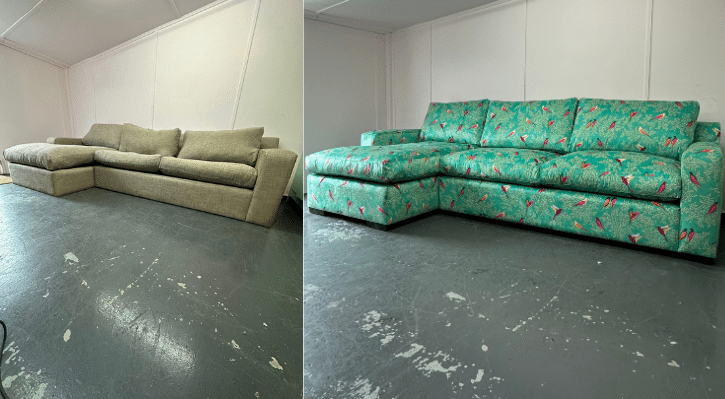
Before and after of an L-shaped sofa I reupholstered using Sara Miller Birds velvet fabric.
Practicality
Children, pets, accident-prone other halves? Even if it’s getting relatively low usage, your sofa needs to be as bulletproof as possible.
When choosing a sofa, at the very least I recommend a stain-resistant fabric. Don’t be fooled by ‘Scotch-guarding’, which evaporates, it’s never as good as built-in stain-resistant technology.
These days fabrics are designed to stand the test of time and a good upholsterer will know the right fabric composition that will suit your household.
Whereas a salesperson in a store is just that, a salesperson, so they can only sell you what they have on offer regardless of your requirements.
“The possibilities of upholstery are endless”
If you have pets, especially cats, stay away from anything woven, as it will become a scratching post in no time.
Polyester velvets are the best option, you can literally brush away pet hair and spills. The pile acts as a barrier giving you time to work on a spillage, but the same cannot be said for cotton velvet, it will show every mark very quickly.
And if you have kids? Is that pale cream colour really such a good idea? Darker shades or patterns are much more forgiving. Not only does a pattern give you durability but it really makes your sofa stand out from the crowd.
Also avoid the temptation to for faux leather as a fool-proof option, it will peel in no time, as it hates moisture and will be a very cold option in a room.
If you are tempted by ‘real’ leather, make sure you are buying real leather. Often manufacturers are selling ‘real’ leather and only a small amount of the sofa is as advertised, the rest is bonded faux leather, which will last no more than two years before it begins to crack and peel.
Look beyond the high street
Smaller manufacturers or custom-built sofas are worth looking into. You don’t have to settle for what’s out there on the high street.
Construction is almost always superior in a good quality, older piece. And if you like the look of it, the possibilities of upholstery to make it meet your exact requirements are endless.
Is buying a new sofa (or anything else) your best bet? Maybe take a look at what’s already out there before you get seduced by the prospect of the January sales.
Next steps
So, the next time you’re purchasing a sofa, consider the idea of buying a pre-loved sofa from sites such as eBay or Facebook Marketplace and then working with an upholsterer.
Rather than having to stress about fabrics, style, comfort or whatever else, an upholsterer can talk you through all of this step by step and help you create a sofa that you love.
Instead of buying a sub-standard, mass manufactured sofa, an upholsterer can create something that will last 15 years and be entirely bespoke and unique.
Do you have a sofa that needs a little love to fulfil its potential? Or do you have the perfect one, but it needs a little revamp? Drop me a line for an initial, no-obligation quote by filling in the online contact form. Alternatively, you can email me directly at hello@test.vintiqueupholstery.com or call me on 07764 182 783.
Stay up to date
Keep up to date with the latest upholstery news and trends, delivered directly to your inbox.